

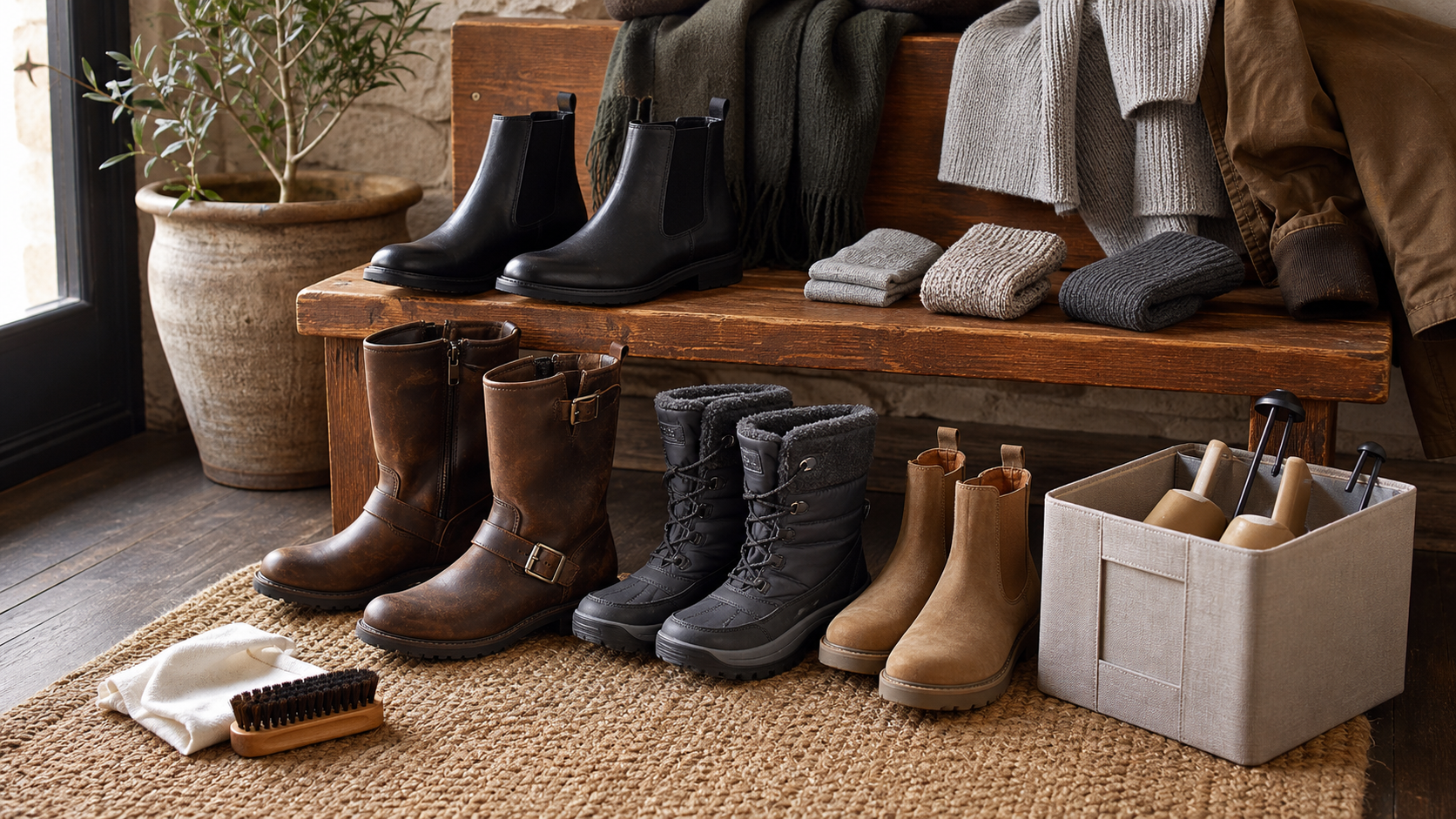
The practical answer: choose transitional-season boots by shape, closure, intended use and the socks you will actually wear. Check toe space, heel movement, instep pressure and calf clearance while standing and walking. Break new footwear in gradually, dry it away from damaging heat, and store it clean and supported. A style name does not prove waterproofing, leather content, insulation, traction or a temperature rating.
Four boot families compared
| Style | Fit focus | Sock starting point | Transition-season use check |
|---|---|---|---|
| Chelsea | Instep and elastic-side entry | Light or medium crew | Check heel hold and opening pressure |
| Motorcycle-inspired | Calf, shaft and closure | Medium crew or boot sock | Confirm intended use; fashion styling is not protective certification |
| Snow style | Toe room with thicker socks | Moisture-managing winter sock | Verify exact lining, sole and weather claims |
| Slip-on | Secure heel without a tight instep | Chosen everyday sock | Test entry, exit and walking hold |
1. Fit both feet late in the day
Feet can differ in length and width and may change through the day. Try both boots with the intended socks, orthoses or insoles. Stand with weight distributed normally. Toes should not strike the front, curl or overlap. The widest part of the foot should align with the widest part of the boot rather than spilling over an edge.
Walk on a clean indoor surface. A small amount of heel movement may occur in some pull-on designs, but persistent lifting, rubbing or gripping with the toes signals a mismatch. Do not buy painfully tight footwear expecting materials to stretch. The American Podiatric Medical Association recommends choosing shoes that fit immediately and matching footwear to the activity.
2. Match the sock before judging size
Sock thickness changes internal volume. A boot fitted with a thin dress sock may feel crowded with a winter sock; a boot sized around a thick pair may slip when worn with a light pair. Bring the actual category you intend to use.
For the Heeled Chelsea Boots, start with the exact size chart and test the heel height and platform while walking. The product title mentions a supportive platform, but that does not establish clinical support or suitability for prolonged wear. With the Plush Warm Chelsea Boots, account for the listed faux-suede upper and rubber sole, while verifying every current material and care statement on the live page.
Avoid layering multiple socks simply to make a loose boot fit. Layers can bunch, increase pressure and trap moisture. If your feet become numb, painful, unusually cold or discoloured, stop and change the fit or footwear.
3. Check shaft and closure on motorcycle-inspired boots
The Mid Calf Plush Motorcycle Boots listing describes a cotton lining and motorcycle-inspired style. Measure around the calf where the shaft ends, then compare with current product measurements if provided. Sit, climb a step and flex the ankle to find edge pressure or closure contact.
Do not infer impact, abrasion or motorcycle-riding protection from appearance. Protective riding footwear requires applicable design and certification information. Treat these as fashion footwear unless the exact listing and documentation explicitly establish otherwise.
4. Leave functional room in snow styles
The Non Slip Warm Snow Boots listing mentions plush lining and a rubber outsole. Those phrases do not create a guarantee against slips, water entry or cold. Surface, wear, contamination, walking technique and weather all affect traction.
Try snow boots with the planned winter sock. Check that insulation or lining does not compress toes together. Government of Canada winter guidance recommends dressing for conditions and watching for signs of frostbite and hypothermia. No consumer boot can supply a universal safe temperature because conditions and people vary.
Inspect tread before each use and remove packed snow or debris using an approved method. Walk slowly on suspect surfaces and use maintained routes. Footwear is only one part of winter risk management.
5. Test slip-on hold through real movements
The Boston Boots listing refers to fur lining and easy slip-on comfort. Verify the exact material description, size chart and care directions for the current variant. During an indoor test, walk, turn, sit and use stairs. The heel should not lift enough to create friction or instability, and the opening should not pinch the ankle.
A pull tab is for controlled entry, not aggressive stretching. Use a shoehorn if appropriate and permitted. Stop forcing the foot if the instep catches; a different width, volume or closure may be needed.
6. Break in gradually without pain
Begin with short indoor sessions on clean floors. Increase time only if skin remains comfortable and walking is natural. Note recurring redness, hot spots and pressure after each test. Protective blister dressings may reduce friction temporarily, but they do not correct a poor fit.
Do not soak boots, freeze bags of water inside them, bend structured components aggressively or apply heat unless the manufacturer specifically approves that method. Unverified stretching techniques can damage adhesives, coatings, linings or shape.
7. Dry according to the exact materials
Remove loose dirt with a method suitable for the listed upper and sole. Take out removable insoles if the instructions permit. Open closures and allow air to circulate at room temperature. Stuffing loosely with clean absorbent paper may help some footwear hold shape and draw moisture, but printed ink can transfer and the product’s directions take priority.
Keep boots away from radiators, fireplaces, hair dryers and direct high heat unless explicitly allowed. Heat can affect adhesives, coatings, synthetic materials and shape. Never assume a treatment designed for one material is suitable for another. Test care products in an inconspicuous area and follow their label.
8. Store clean, dry and supported
Before seasonal storage, ensure boots are fully dry and free from salt, soil and organic debris. Use boot shapers or acid-free paper without forcing the shaft. Store pairs upright or in a breathable box in a cool, dry area away from direct sunlight, pests and crushing weight.
Canada’s Competition Bureau explains that textile labels identify fibre content and dealer information. Consult both the textile label and product-specific instructions rather than treating “fur,” “plush,” “suede” or “leather” as interchangeable. Recheck stored boots for odour, mould, cracking, loose soles or degraded fasteners before wearing them again.
Ten-minute fit and care audit
- Confirm the exact product, size, variant and current material statements.
- Wear the socks and insoles planned for that boot.
- Check both feet, toes, instep, heel and shaft.
- Walk, turn, sit and use a step indoors.
- Reject pain, numbness, pressure or unstable heel movement.
- Break in with short sessions; do not force stretching.
- Clean and dry only by the stated method.
- Store fully dry with light shape support.
- Inspect soles and closures before seasonal reuse.
- Never infer waterproofing, traction or temperature performance from style alone.
Frequently asked questions
Should boots feel tight so they can stretch?
No. They should not cause pain, numbness or cramped toes at purchase. Material behaviour varies, and stretch cannot fix every shape mismatch.
Can I wear two pairs of socks for warmth?
Extra layers can crowd the boot and create folds or pressure. Use a suitable single sock and ensure functional toe room.
Are snow boots guaranteed not to slip?
No. Product naming cannot guarantee traction on every wet, icy or contaminated surface.
Can I dry wet boots beside a heater?
Use the exact care instructions. Direct high heat can damage many materials, coatings and adhesives.
Are motorcycle-style boots protective riding gear?
Not unless the exact product documentation identifies applicable protective design and certification. Styling alone is not evidence.
Bottom line
For changing seasons, fit the boot and sock as one system. Compare exact listings, test both feet, build wear time gradually, and use material-specific drying and storage. Comfort and care come from evidence and fit—not from assumptions attached to a style name.